Appearance
Gaussian splats, a lineage
Written November 2026. This stuff moves fast, so the last few paragraphs in particular will date quickly.
My half remembered summary of where gaussian splats came from. TLDR: It's fancy photogrammetry that handles view dependent effects, using machine learning techniques as part of the creation process.
Photogrammetry
Photogrammetry is the basis of it all. At some point you always need to have lots of images, they get turned into lots of solved cameras, which generate lots of coloured points in space, which eventually become meshes.
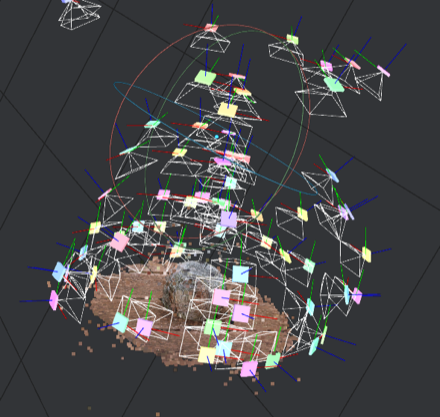
Solved cameras and points in Meshroom.
If you think about what photogrammetry is, a vague way to think about it is 'for a point in space, what is the colour there?'. Mostly the answer is 'nothing' for the majority of empty space. For points on the surface of your photogrammetry mesh you get a colour, and because it's a mesh, you can get a normal too.
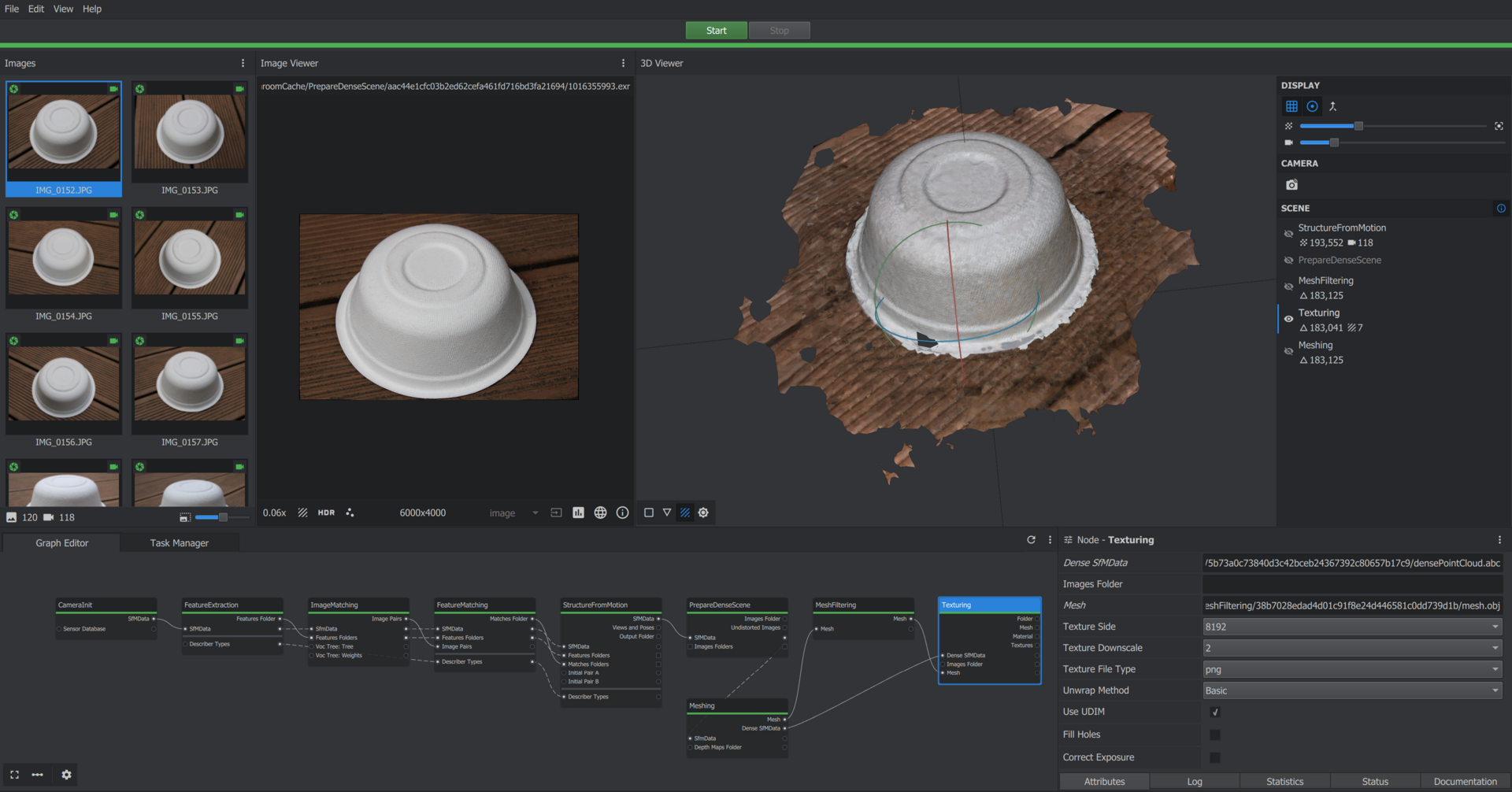
The finished mesh in Meshroom.
NeRFs
Next came NeRFs. A NeRF treats the scene as a volume, and returns a value at every point in the volume, that value being colour and density. That colour, unlike photogrammetry, is also aware of the direction you're querying from. If you look at a point from one direction you might get green, from another direction you get white. Minor detail, density doesn't change with direction, otherwise you'd get shifting shapes.
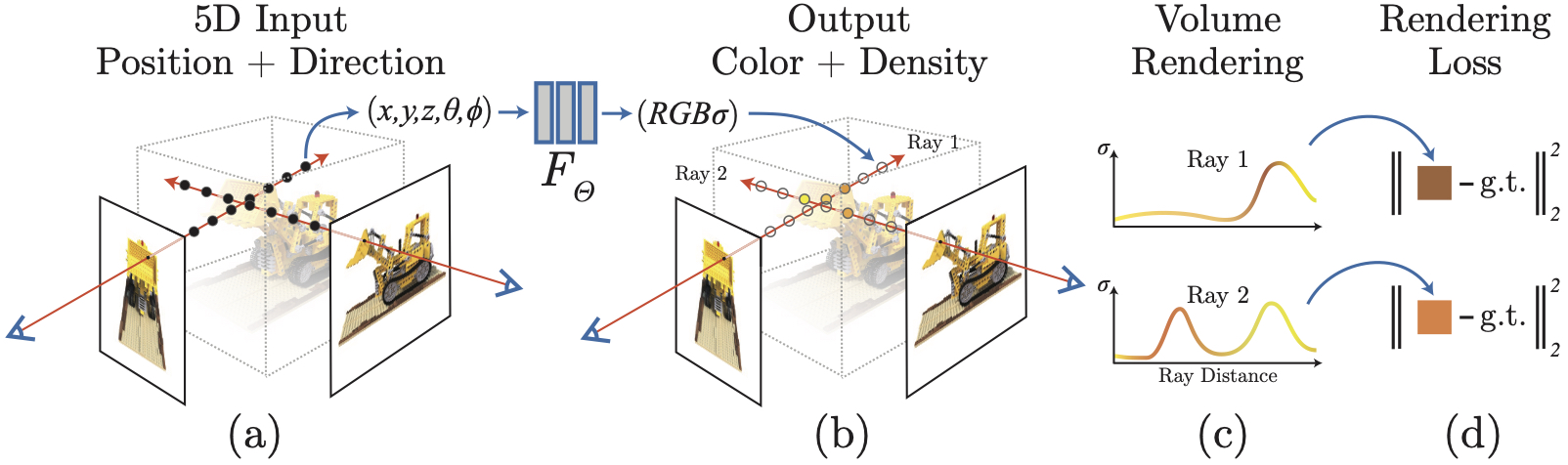
The classic lego NeRF figure: rays through the volume, colour and density at each sample.
This means it can capture all the tricky stuff that photogrammetry can't. You can do volumetric effects like steam, fire, clouds, because you have varying density instead of a mesh surface. NeRFs are also great for 'fuzzy' things, so rather than capturing every single blade of grass on a field, you get a fuzzy representation of the entire thing. Same with hair, fuzzy clothing, motion blurred objects. And because you can get a different colour depending on the ray direction, that means view dependent effects, ie reflections, refractions. That's why NeRFs looked so good compared to very flat looking photogrammetry.
NeRF renders from the original paper. Fuzzy palm fronds, reflections in windows, but it can also do hard concrete, detailed hard surface lego.
Absolutism of photogrammetry vs relativism of NeRFs
It's also interesting to realise how this avoids a key problem with photogrammetry. To make a solid mesh the photogrammetry algorithm has to get consensus from at least 2 cameras/images, ideally more, so they all agree 'this point looks green from all cameras, it must be a surface that is green'. Photogrammetry issues arise from when they disagree; if the cameras agree on a point in space, but it changes colour from each view, it struggles to reconstruct that point. It's why photogrammetry workflows usually advise 'diffuse surfaces only, coat things in talc if you need to, avoid all reflective/refractive/fuzzy shapes'.
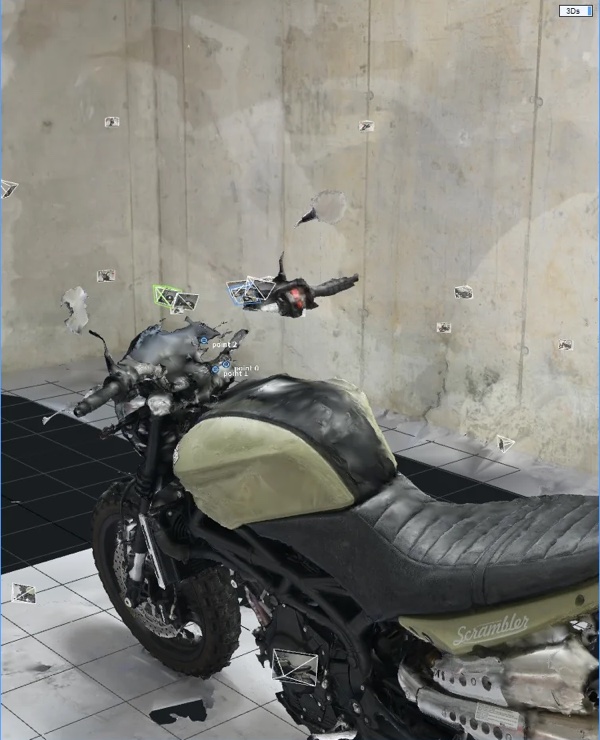
RealityCapture on a motorbike. The matt tank and seat are fine, the shiny dash and chrome handlebars are torn up and floating.
A photogrammetry head scan. Even the small shifts in skin specular from camera to camera turn into lumpy noise across the face, and the fuzzy hair confuses it completely.
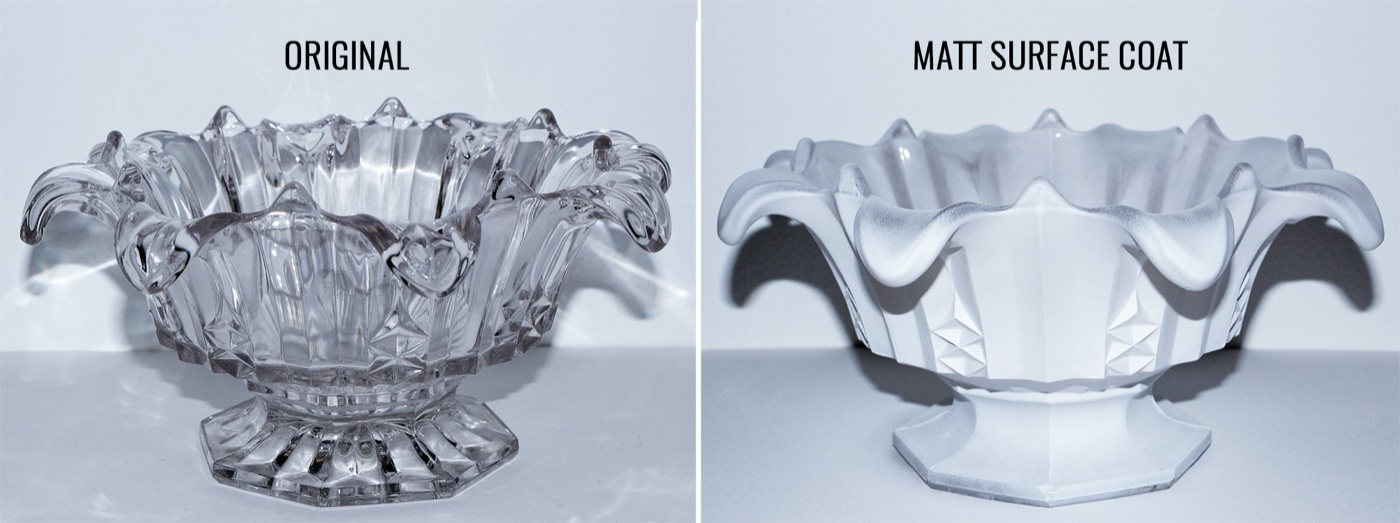
The photogrammetry fix: coat the glass in matt spray so every camera sees the same thing.
NeRFs (and later gsplats) embrace this difference of opinion between different POVs. If multiple cameras agree that this point in space is green, great, it must be a diffuse green thing. But if one says it's green, the other says it's white, the other doesn't see it, then that becomes part of the view dependent coding; when viewing the NeRF, if your view matches the green view, you see green, if your view matches the white, you see white etc. That's how they capture all the photographic realism and fuzziness that photogrammetry lacks.
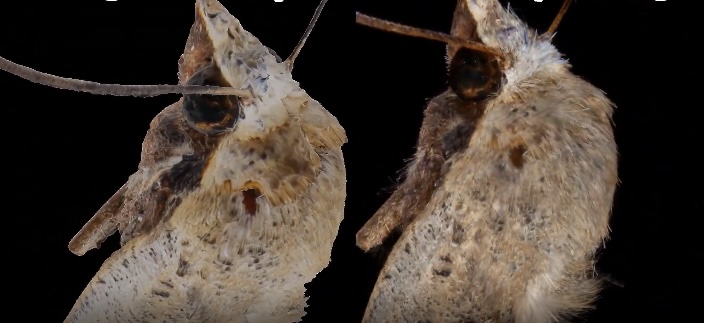
The same moth. Left is photogrammetry, which loses the fur and leaves hard edges; right is a gsplat, which keeps the fine fuzz.
NeRFs are slow
The problem with NeRFs was their volumetric nature. Standard volumes are rendered by marching a ray through the volume, at each little ray march step it queries the nearest voxel density and colour, runs a lighting calculation. This can be slow.
NeRFs are also raymarched, but they don't have voxels. Instead they run a little neural network at every sample along the ray. Hundreds of samples per ray, a ray per pixel. This makes them incredibly slow to train and to render. Later versions trained in minutes and got to a few frames a second, but full quality realtime never happened. The versions that did get there baked the NeRF into meshes or grids first, so they weren't really NeRFs any more.
The crossover with LLMs, AI, ML
The term 'Neural' might be a red flag to anti-AI folk. There's a real connection; from about 2012, people worked out how to use GPUs to train machine learning models, and the tools for doing that got very good, very fast. LLMs and generative AI rely on GPU compute for training, and the end results of LLMs and generative AI are massive neural networks. NeRFs also train using GPU compute, as do gsplats, even though they don't use a neural network.
But apart from the GPUs and the basic training maths, there's not much else in common. An LLM is a massive network trained on scraped data; a NeRF's network is tiny, a few megabytes, trained on your one scene. Gsplats are the same, learning only from your own photos, and neither invents anything that wasn't in front of the camera. And generally speaking the training is run on a single computer, not massive data centres.
Gaussian Splats
Gsplats came along as a faster alternative to NeRFs. Same idea of capturing all those different points of view, but rather than a volume and a neural network, it's a point cloud, optimised directly against the photos.
Each point is a soft fuzzy blob. You've probably used a gaussian blur, seen a bell curve in maths. This general concept of 'most stuff in the middle, fading off at the extremes' is called a gaussian. These soft fuzzy 3D blobs are called 3D gaussians.
These blobs don't have to stay circular or spherical, they can be stretched and scaled to better fill the scene. As well as having their stretchy fuzzy properties, they also store opacity, and colour that changes based on the angle they're viewed from. No neural network, no ray marching; GPUs just draw them like a big pile of sorted, semi transparent sprites, which they're very good at. 'Splatting' is an old graphics term from around 1990, for drawing a point by stamping a soft footprint onto the screen, like a paint splat. Draw gaussians that way and you get gaussian splats, shortened to gsplats by the cool kids.
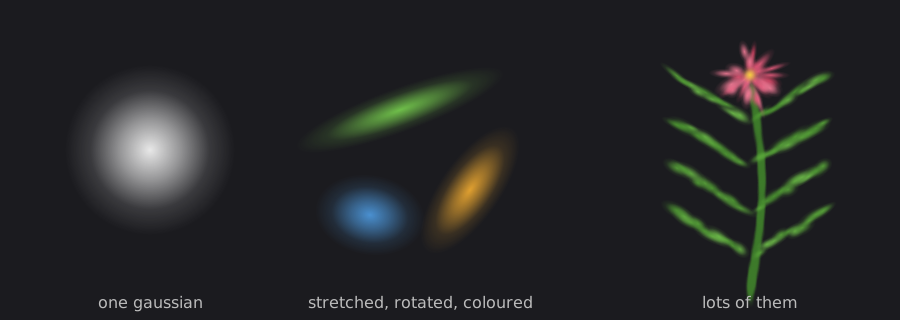
Gaussians: one on its own, stretched and coloured, and lots of them building a shape.
Gsplats are blazingly fast to render, realtime on a laptop or a phone, even with millions of splats. The files can get big though, hundreds of megabytes isn't unusual.
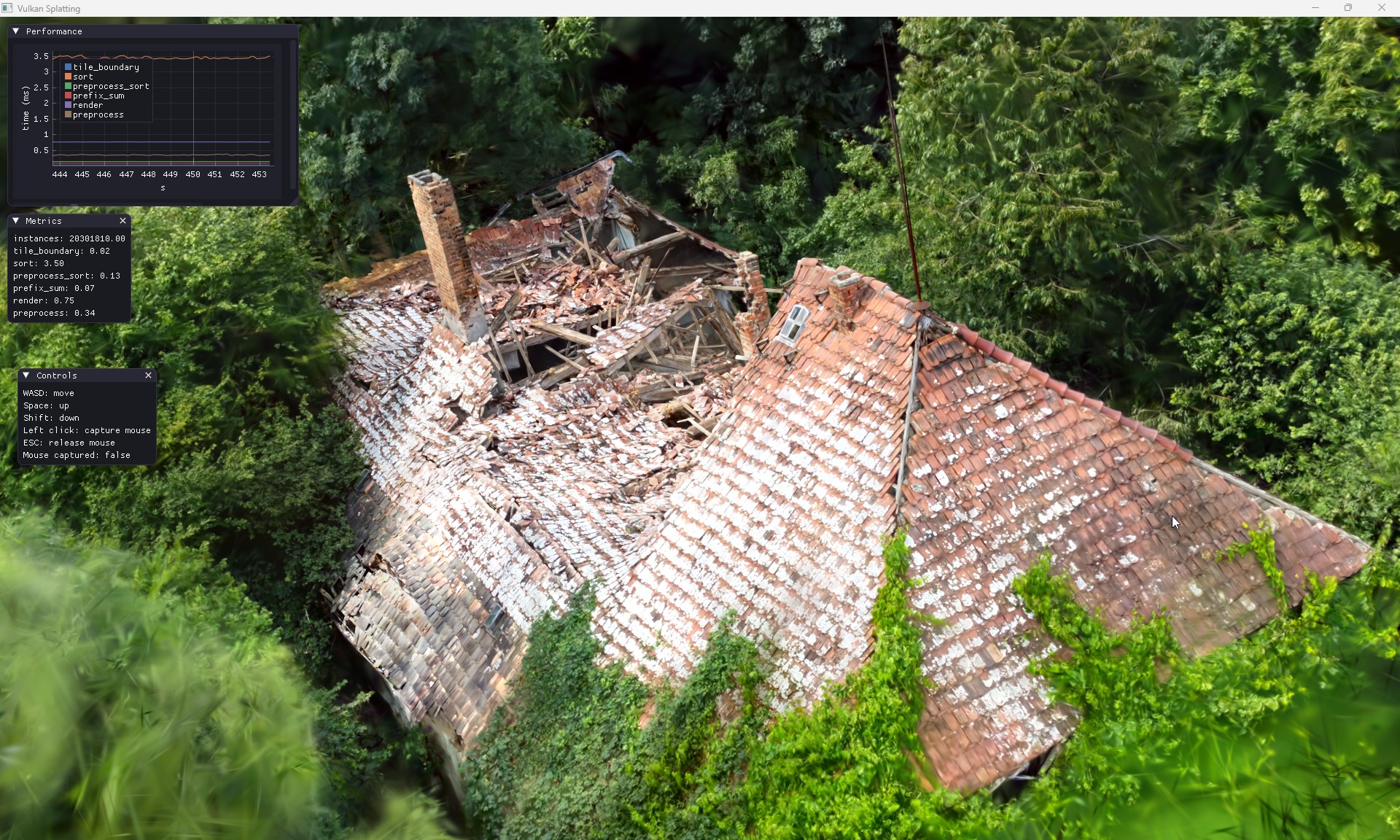
A collapsed building captured as a gsplat, shown in VulkanSplatter.
They're a brittle format, but there's lots of research and innovation going on. Traditional CG can sometimes feel like it's a solved problem, it's hard for researchers to find new things to do, but gsplats are a big new green field with lots of potential, there's hundreds of new papers every year.
So while the lineage is photogrammetry > NeRF > gsplat, that's a history of the ideas, not a pipeline; you just go images > solved cameras > gsplats. The original NeRFs took the best part of a day to train, then got down to minutes, early gsplats took half an hour or so, and now there are methods that can make a gsplat from a handful of photos in seconds. It used to be assumed it was a brittle static format that had baked in lighting, but people have found ways to support animation, editing, relighting, rigging. It's really interesting tech.
Links
- NeRF: Representing Scenes as Neural Radiance Fields for View Synthesis (Mildenhall et al, 2020), the original NeRF paper.
- Instant Neural Graphics Primitives (Müller et al, 2022), the one that got NeRFs training in minutes rather than hours.
- 3D Gaussian Splatting for Real-Time Radiance Field Rendering (Kerbl et al, SIGGRAPH 2023), the original gsplat paper.
Images: Colin Kranz and Jurdein via Wikimedia Commons (CC BY-SA 4.0, Meshroom shot cropped), NeRF figure and renders from Mildenhall et al (MIT).